Article originally published in WINGS, 28/05/2025
By Luisa Lima, Communication and Knowledge Manager at IDIS
In a time of global uncertainty marked by social fragmentation, economic volatility, and pressures on democratic institutions, it’s easy to feel detached from the possibility of collective transformation. In such moments, it helps to look at practices that, while not perfect or universally applicable, offer useful directions.
Rather than becoming paralysed by complexity, many actors in Brazil’s philanthropic ecosystem are experimenting with bold and adaptive strategies. The annual report ‘Perspectives for Brazilian Philanthropy’, released by the Institute for the Development of Social Investment (IDIS), highlights six key trends shaping the philanthropy landscape in 2025. These trends reflect urgency, creativity and, above all, hope in action – showing how Brazilian philanthropy is responding to national challenges, while offering ideas that may resonate beyond its borders.
Like many countries, Brazil is increasingly affected by climate change and its implications. Floods, droughts, and storms are becoming more frequent and severe, often overwhelming the capacities of public and private sectors to respond. In this context, a growing number of philanthropic efforts are moving from reactive aid toward more structured and systemic strategies. Local Community Foundations (CFs), such as Fundação Gerações and ICOM, are helping lead this shift, creating rapid-response funds that mobilise local knowledge, donor networks, and public-sector partnerships to provide both immediate relief and long-term recovery.
One example is the RegeneraRS Emergency Fund, created after the May 2024 devastating floods in Rio Grande do Sul, a state in the deep South of Brazil. The disaster affected 496 cities, displaced more than 150,000 people, and temporarily shut down the state’s main airport. The fund blends philanthropic capital with credit tools1 to support small businesses and rebuild affected areas, a locally rooted model with potential relevance for climate-vulnerable regions elsewhere.
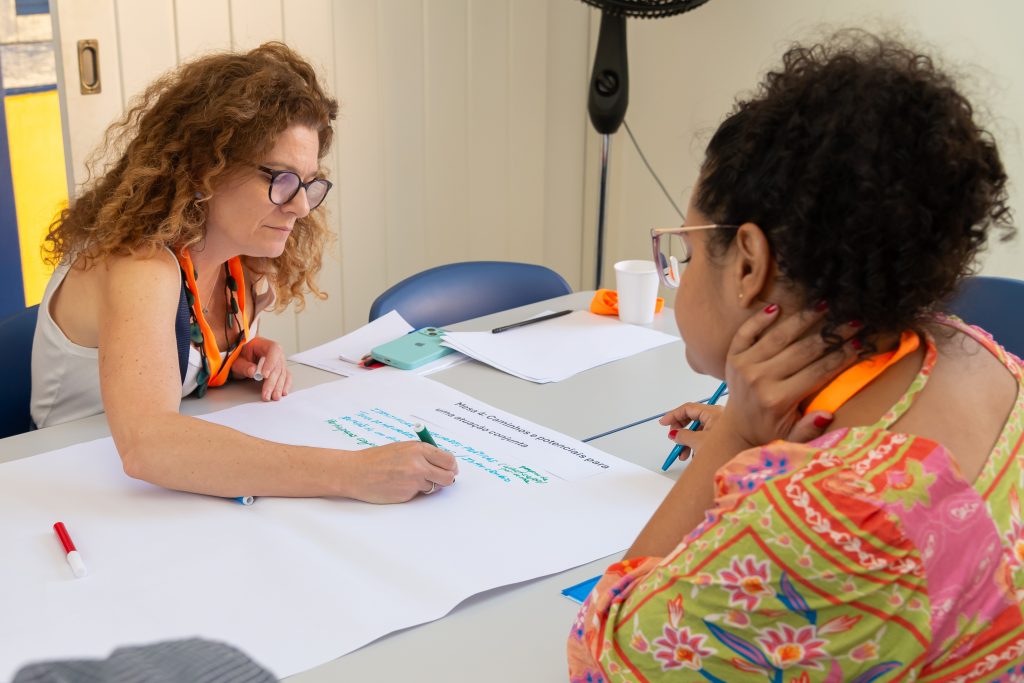
Transforming Territories leadership meeting 2025. Photo by André Porto.
Mental health is another critical issue. Brazil faces high rates of psychological distress, and burnout is increasingly common among civil society leaders and workers, especially those from historically marginalised groups. Local organisations are beginning to prioritise a ‘culture of care’, creating spaces for emotional reflection, peer support, and institutional deceleration. While these efforts are still emerging, they point to a global truth: social impact work cannot continue without emotional sustainability. The philanthropy sector must consider embracing mental well-being as a programme area and the basis for civic engagement.
Institutional capacity is also gaining prominence. In Brazil, the conversation around capacity building has evolved beyond technical skills to include strategic governance, leadership development, sustainable funding models, and adaptation to shifting regulations. Supported by actors such as IDIS, GIFE, and BTG Soma, many organisations are undergoing internal transformations. Flexible funding from donors like Movimento Bem Maior and Instituto ACP further reinforces this shift, emphasising trust and long-term resilience over short-term project outputs. Strengthening the backbone of an organisation, rather than just its front-line programmes, is proving essential to meaningful, sustained change.
Volunteerism, too, is being reimagined. Once limited to direct engagement with specific programmes, volunteering in Brazil is increasingly integrated into decision-making and governance. A notable example comes from the São Paulo Museum of Art (MASP), the largest museum in Latin America. There, a governance overhaul brought business leaders and professionals onto the board, enabling a financial turnaround, the creation of an endowment fund, and a major operational expansion. This approach to strategic volunteerism offers lessons for other philanthropic ecosystems aiming to build institutional resilience and bridge sectors.
In contrast to some parts of the world experiencing political backlash against diversity and inclusion, Brazil continues to see important progress, albeit not without resistance. Initiatives like the Pact for Racial Equity are using ESG metrics to hold companies accountable, while large institutions such as Itaú Bank have committed to public targets and substantial investment in Diversity and Inclusion. These actions demonstrate how philanthropy can uphold inclusive values, even when political environments are unfavourable. In this context, resistance is not reactionary; it is regenerative.
Finally, the practice of private social investment is spreading. Historically driven by large corporations, the field is now seeing increased participation from small and medium enterprises (SMEs), which make up over 90% of businesses in Brazil. Programmes like Commitment 1%, inspired by the global Pledge 1% movement, encourage SMEs to allocate a share of profits to community development. New regulations, such as CVM Resolution No. 193 mandating sustainability disclosures by 2026, are also nudging smaller businesses toward more socially responsible practices.
Together, these developments reflect an ecosystem in motion, not by universal breakthroughs, but by meaningful experimentation, adaptation, and commitment. Brazilian philanthropy offers signals from a complex and deeply unequal society navigating profound change.
The question for global philanthropy is not whether to replicate these efforts, but how to draw from them, translating local insights into broader strategies that are just as bold, inclusive, and resilient as the challenges we all face.
1. The structure catalyses other initiatives on housing, education, business, and urban regeneration, by making donations and absorbing the risks. It’s the ‘fund of funds’.